The complete book
The Inner Operating System
Debugging the Human Mind for a Meaningful Life
Anand Gopalan
4 parts · 25 chapters. Every chapter begins with a question rather than an instruction.
Publication details
- Publisher — to be confirmed
- Publication date — to be confirmed
- ISBN — to be confirmed
- Book purchase URLs — buying links will appear here once available
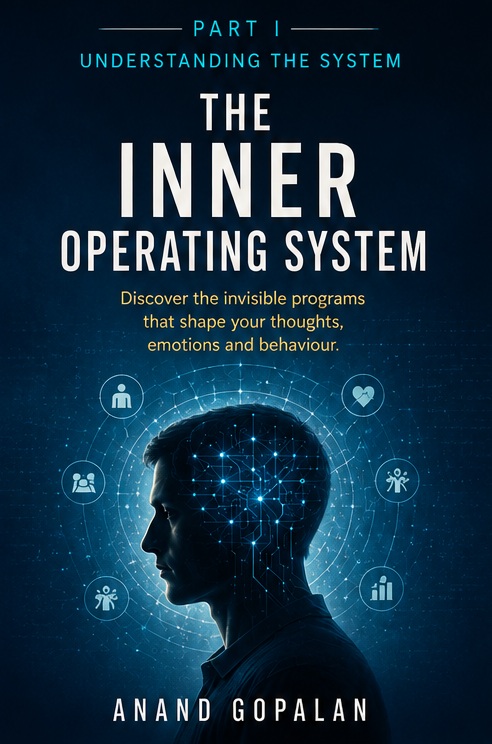
Part I
Understanding the System
- 01
You Are Running Software You Didn't Write
How much of your daily behaviour did you consciously author?
Much of what feels like personality began as instruction — absorbed early, repeated often, rarely questioned. The chapter opens the possibility that some of it can be examined.
- 02
Who Installed Your Beliefs?
Where did your assumptions about yourself actually come from?
Beliefs behave like configuration: quiet, persistent, and decisive. Tracing their origin is the first step toward deciding whether to keep them.
- 03
The Architecture of the Mind
What are the moving parts you are working with?
A working map of thought, feeling, attention and impulse — offered as a tool for observation rather than a claim about neuroscience.
- 04
The Database of Memory
Is memory storing the past, or reconstructing it?
Memory is less an archive than a retrieval process. What returns is shaped by the state you are in when you reach for it.
- 05
The Programs Called Habits
What executes before you decide anything?
Habits reduce effort, which is why they survive. The chapter examines how a useful shortcut becomes an unexamined default.
- 06
The Bugs in the System
What if a recurring problem is a pattern rather than a flaw in you?
A bug is not a moral failure. It is behaviour producing a result nobody intended — and behaviour can be traced.
- 07
The Anxiety Loop
What keeps the loop running long after the threat has passed?
An examination of anticipation, avoidance and relief as a self-sustaining cycle. Reflective, not clinical.
- 08
The Comparison Engine
Whose scoreboard are you being measured against?
Comparison runs as a background process, consuming attention and quietly rewriting what you consider enough.
- 09
The Approval Seeking Program
What are you willing to pay for someone else's agreement?
Approval is a legitimate human need and an expensive operating principle. The chapter separates the two.
- 10
Emotional Legacy Code
Which responses were inherited rather than chosen?
Some emotional reactions belong to an earlier situation that no longer exists. Recognising the inheritance changes what you do with it.
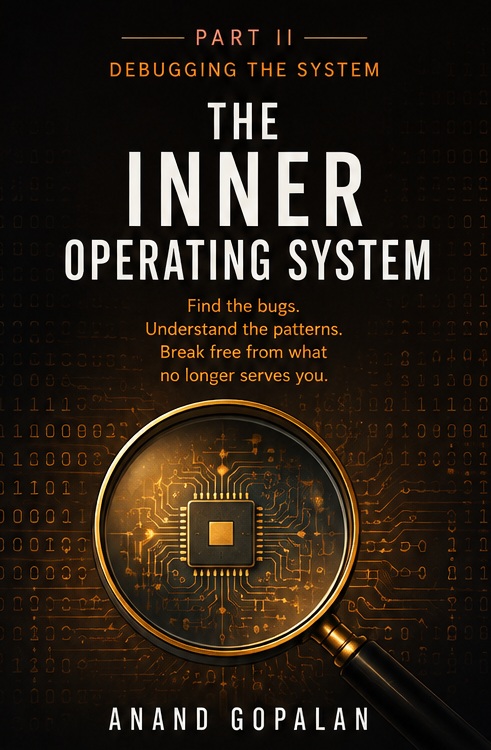
Part II
Debugging the System
- 11
The Observer Enters the System
What changes the moment you begin watching?
Observation is not the same as judgement. This chapter introduces the stance that makes everything after it possible.
- 12
Root Cause Analysis
Are you addressing the symptom or the cause?
A patient method for tracing a reaction back through impulse, emotion and interpretation to the belief underneath it.
- 13
Refactoring Your Beliefs
Can a belief be revised without pretending it never helped?
Refactoring keeps the function and rewrites the implementation. Applied inward, it is gentler and more durable than force.
- 14
Learning to Let Go
What are you still carrying because putting it down feels like losing?
Letting go examined as a deliberate act rather than a mood — including what makes it genuinely difficult.
- 15
Breaking the Dependency Graph
Which dependencies strengthen you, and which quietly govern you?
Every life runs on dependencies. The question is whether they are chosen, visible, and survivable.
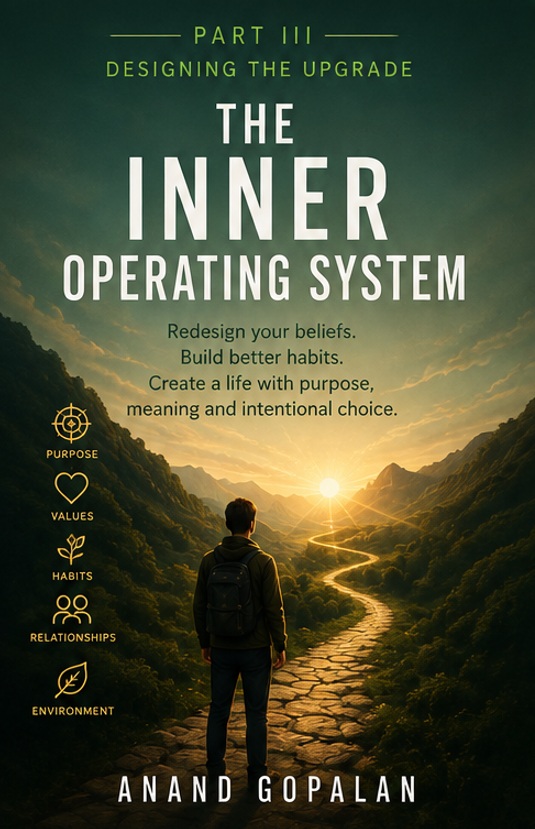
Part III
Designing the Upgrade
- 16
The Power of the Pause
What becomes possible in the space before the reaction?
Two seconds is not a technique for perfection. It is the interval in which a first impulse stops being the final decision.
- 17
Designing Your Inner Architecture
If you were designing this system deliberately, what would you change?
Moving from repair to design: structures, environments and defaults that make the intended behaviour the easy one.
- 18
Purpose: The Operating System's North Star
What is the system optimised for?
Purpose treated as direction rather than destiny — the reference point that makes smaller decisions coherent.
- 19
Resilience
Can you be affected without being redefined?
Resilience as stable core and flexible structure, rather than the pretence of being untouched.
- 20
The Human Network
Who is in the network that holds you?
No one runs as a single-server system. The chapter examines relationships as architecture, not decoration.
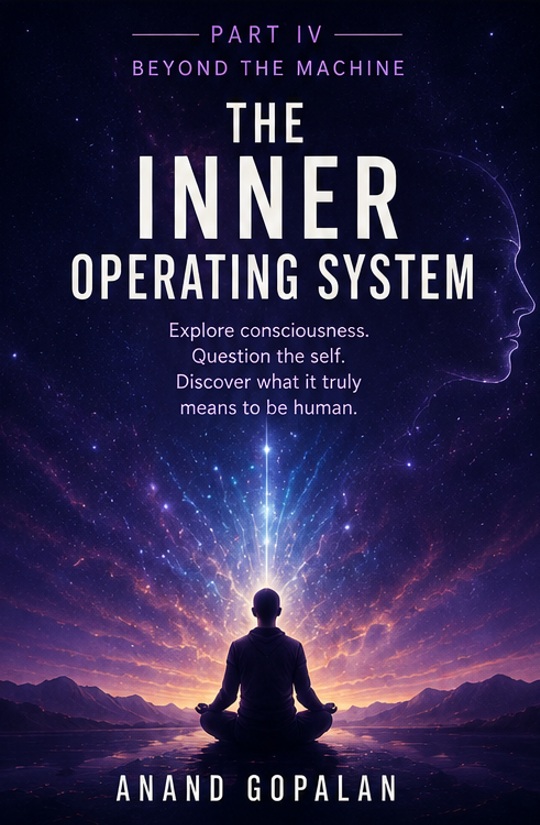
Part IV
Beyond the Machine
- 21
Is the Mind the Same as Consciousness?
Is the content of experience the same as the fact of experiencing?
A careful distinction between mental activity and awareness of it — and why the difference matters.
- 22
Who Am I?
If everything you can observe is not the observer, what remains?
The oldest question, approached through the same method the book has used throughout: observation before conclusion.
- 23
The Machine That Became Intelligent?
Does intelligent behaviour imply an inner life?
What machines demonstrably do, what they do not demonstrably have, and why the gap is worth stating precisely.
- 24
Can Consciousness Be Computed?
Is consciousness a process, a property, or something else entirely?
An honest survey of an unsettled question, keeping scientific, philosophical and spiritual claims distinct.
- 25
Beyond the Machine — The Human Operating System 2.0
What does the metaphor leave out?
The closing chapter returns the metaphor to its place as a tool, and asks what remains once its usefulness ends.
Reflections by email
One idea at a time.
A short letter with reflections from the book and new writing. No frequency promised yet, and nothing sent without consent.
PlaceholderNewsletter provider not yet configured — sign-up will be enabled once an email service is connected.